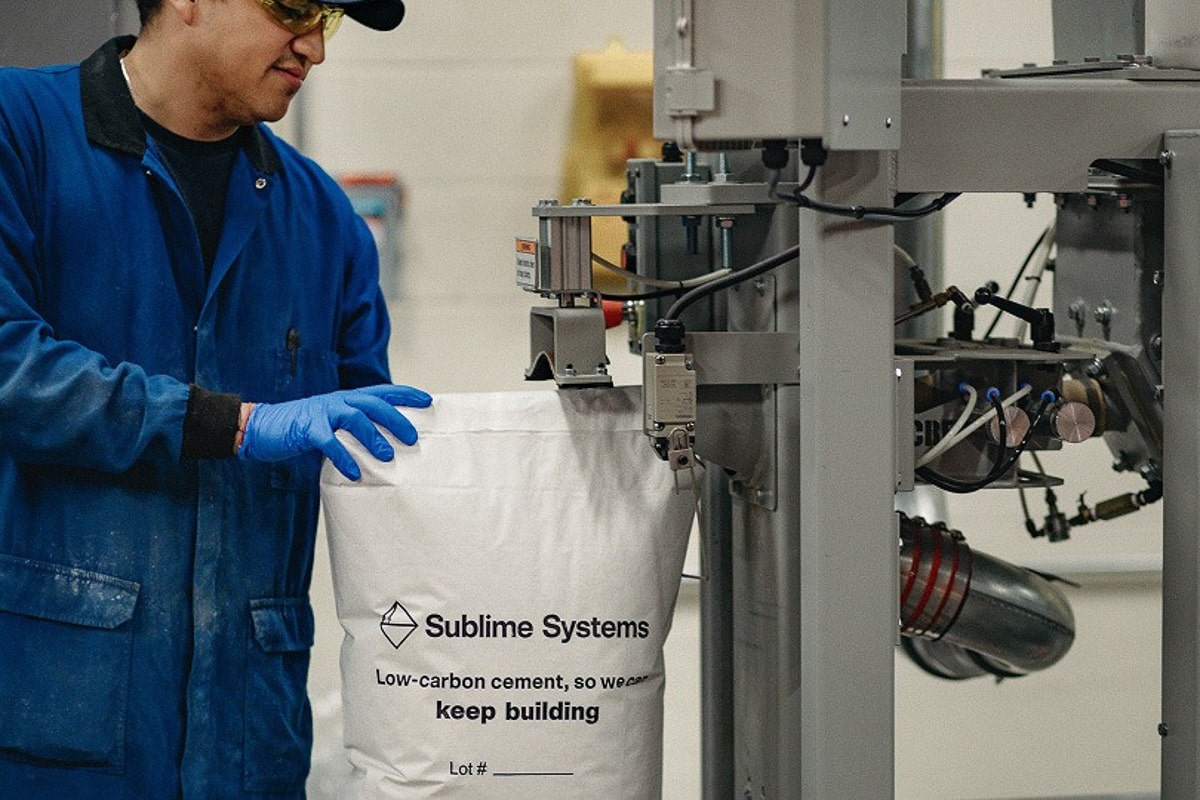
Massachusetts startup Sublime Systems created a new formula that can directly replace the most widely used form of cement globally. (Image courtesy of Sublime Systems.)
Massachusetts startup Sublime Systems created a new formula that can directly replace the most widely used form of cement globally. (Image courtesy of Sublime Systems.)
Cement production emits roughly the same amount of carbon dioxide as all of the cars in the world combined. Massachusetts startup Sublime Systems found a way to make it without its largest source of emissions.
The Massachusetts startup Sublime Systems developed a new cement production system that requires no fossil fuels and eliminates the use of carbon-heavy limestone. A new way to make cement may not sound all that exciting at first, but reducing the carbon footprint of this widely used material could be equivalent to taking over a billion cars off the road.
Cement is the glue that holds concrete together, and concrete — a combination of cement, gravel, and other fillers — is the most commonly used material in the world. If the global cement industry were a country, it would be the third- or fourth-largest carbon dioxide emitter in the world, according to the World Economic Forum, one of many organizations advocating for a new approach to cement manufacturing.
“Global cement manufacturing is responsible for about 8 percent of the world’s total carbon dioxide emissions,” the World Economic Forum reported last year.
“To put this in perspective, it’s roughly equivalent to the carbon dioxide emissions from all the cars in the world,” adds the U.S. Geological Survey.
Unlike decarbonizing other high-emitting sectors, such as transportation, reducing carbon emissions from cement is not as straightforward as replacing dirty fuels with clean ones. Only about a third of the carbon dioxide emissions from cement production come from the fuel used to power kilns, which heat limestone along with other materials to produce cement. The remaining 66 percent comes from the limestone itself, according to the U.S. Geological Survey. Limestone consists of approximately 50 percent carbon dioxide by weight, which is released as a gas when heated.
Those dual sources of carbon dioxide leave the cement industry with two opportunities to decarbonize. Like other industries, cement makers can reduce their carbon emissions by switching to alternative fuels or deploying carbon capture systems, and they could cut emissions to zero or near-zero by reducing or eliminating limestone in their supply chains.
A ‘Sublime’ New Vision for Sustainable Cement
That brings us back to Massachusetts-based Sublime Systems and its “Sublime Cement,” a new formula that can directly replace OPC (Ordinary Portland Cement), the most widely used form of cement globally.
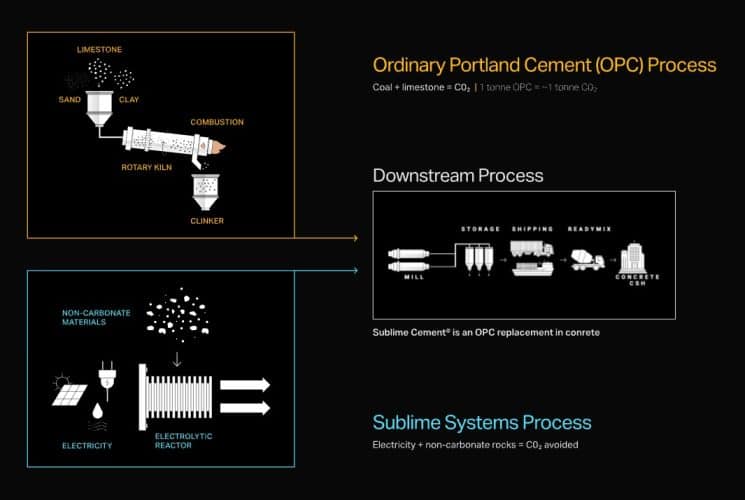
In contrast to the fossil fuels used in OPC production, Sublime deploys a fully electrified, no-heat process based on a chemical reaction with water. Called electrolyzers or “water-splitters,” these systems are commonly used to produce hydrogen from water. Sublime uses the same system to prompt a reaction in any calcium-containing mineral, including those that contain no carbon dioxide, thereby releasing the calcium, the primary component of cement.
Sublime’s cement-making process is fully electric and based on a chemical reaction with water, requiring no heat and no limestone. (Image courtesy of Sublime Systems.)
Electricity can be generated from wind, solar, or other renewable energy sources, and Sublime does not rely on limestone as a feedstock.
The company’s electrochemical process draws calcium and other cement ingredients from alternative sources to produce cement that meets U.S. performance standards under Code C1157, a global benchmark established byASTM (Advancing Standards Transforming Markets) in 2010. To meet the standard, cements must demonstrate strength and heat resistance, among other requirements.
While the building industry is traditionally resistant to new materials, that’s starting to shift as construction firms respond to client demand for new and more sustainable products, said Joe Hicken, Sublime’s SVP of development and policy.
“The way America builds today rests on the general contractors that build our hospitals, roads, and schools. They are the entities that respond to infrastructure owners. You can have the best product on Earth, but if the general contractors do not buy in, you’re not going anywhere,” Hicken told TriplePundit. “America’s builders want this material. They’re listening to their customers.”
Sublime put in the extra effort needed to rally confidence among builders. The firm’s elaborate series of industry-approved validation steps included a life-cycle assessment conducted by Climate Earth, a firm specializing in the cement industry. Climate Earth found that Sublime’s manufacturing process can reduce the material’s global warming potential by more than 90 percent compared to ordinary Portland cement, without relying on carbon capture, forestry credits, or other offsets.
Climate Earth calculated a global warming potential of just 72 kilograms of carbon dioxide per metric ton for Sublime Cement, compared to 922 kilograms for the average U.S. cement producer. “The remaining emissions were largely related to the mining and transportation of feedstocks and waste and wastewater treatment,” according to a statement from Climate Earth and Sublime.
Sublime also set the stage for widespread acceptance in the construction industry through its marketing. In June, the company launched a distribution channel partner program to connect general contractors with customers eager to deploy low-carbon materials. The program launched with leading industry participants already participating, including Turner Construction Company, STO Building Group, and Samet Corporation, among others.
Corporate Customers Want Sustainable Cement
As one indication of client support for the sustainable cement movement, Microsoft signed a contract last spring to purchase up to 623,000 tons of Sublime Cement through an Environmental Attribute Certificates program over six years. The agreement supports Sublime’s plan for establishing a string of “megaton” cement factories. With these certificates, Microsoft can either use the cement itself or transfer it to other projects near a Sublime facility to reduce transportation-related carbon emissions.
“While we prioritize deploying physical material whenever possible, this [Environmental Attribute Certificate] approach helps both buyers and sellers overcome geographic, supply chain, cost, and other barriers that make it challenging to introduce new technologies,” said Katie Ross, Microsoft’s director of carbon reduction strategy and market development.
Next Steps Towards Sustainable Cement
Sublime took another step toward scale-up in August when the leading data center developer, Stack Infrastructure, used Sublime Cement in a pilot project at its campus in Prince William County, Virginia, marking the first use of the product in the data center industry.
The new cement was poured on the surface of a heavily used loading dock, a project that’s small in size but large in potential impact. “Across the many concrete applications in a data center, loading docks endure significant wear and stress,” that will put the material to the test, Leah Ellis, Sublime cofounder, said in a statement.
While Sublime continues to pursue its scale-up plans regardless of the current state of U.S. energy policy, other stakeholders were forced to recalibrate their activities in the country. The global cement producer Heidelberg Materials, for example, was on track to install a carbon capture system at its facility in Mitchell, Indiana, with a $500 million cost-sharing grant from the U.S. Department of Energy issued in 2024. The Trump administration revoked the grant in June, but the company continues to pursue its carbon capture plans globally.
Other new decarbonization pathways are also emerging, partly enabled by artificial intelligence-enhanced supply chain tools. The U.S. organization ClimeWorks Foundation highlights the use of calcined clay (heat-dried clay) to supplement limestone, for example. The organization also notes photosynthetic microalgae that can “grow” new limestone and a new cement recycling process that uses electric furnaces instead of fossil fuels.
While emerging technologies face barriers to commercial scale-up, a growing number of researchers and private-sector innovators are dedicating time, energy, and investor resources to decarbonization pathways for cement that could have a massive global impact. That trend shows no sign of slowing down, even without U.S. policymakers’ support.
Article by Tina Casey, who writes frequently for TriplePundit and other websites, with a focus on military, government, and corporate sustainability, clean tech research, and emerging energy technologies. She is a former Deputy Director of Public Affairs of the New York City Department of Environmental Protection, and author of books and articles on recycling and other conservation themes.