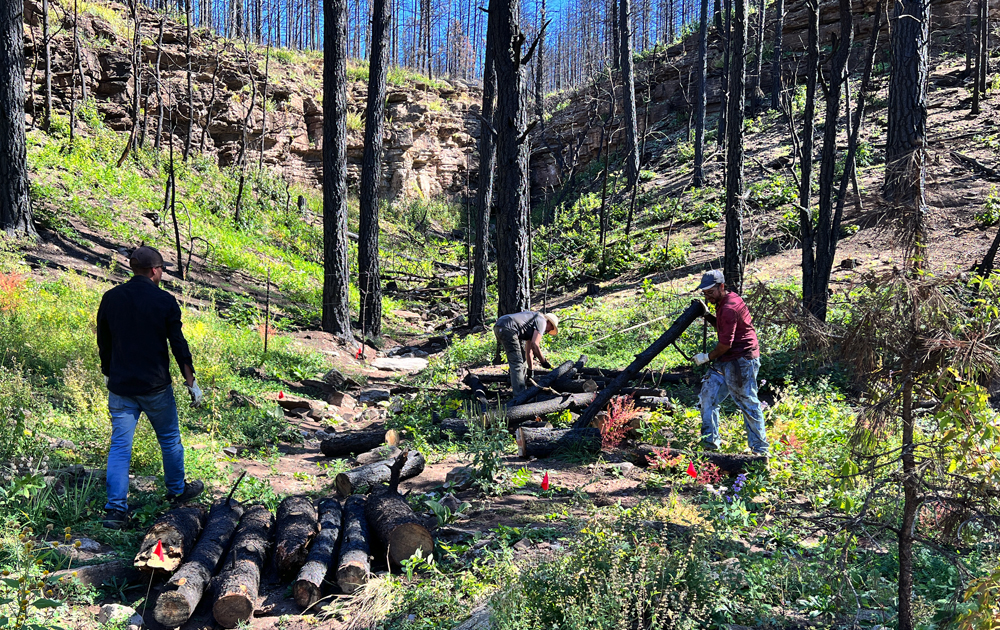


In New Mexico, the health of forests, headwaters, and aquifers determines whether farmers and ranchers can graze, plant, irrigate and harvest. Wildfire, flood and drought cascade from headwaters into broken acequias and lost crops, undermining the economies and traditions of rural communities. We can’t prevent every storm, but we can reduce their long-term impacts through better stewardship — and we must invest in that resilience through conservation finance.
According to the Conservation Finance Network, conservation finance encompasses the full range of tools that fund and sustain ecological outcomes — from grants and philanthropy to market-based mechanisms such as ecosystem payments, water or carbon credits, and blended-capital investments. In essence, it’s about matching the scale of ecological need with capital models that extend beyond grants and one-time appropriations. In New Mexico, conservation finance becomes especially powerful when it links forest restoration, acequia resilience and groundwater recharge into one hydrologic and financial framework. Water is life here, and we are at a moment of reckoning. Shifting how we value, and finance, water stewardship will determine whether agriculture remains viable in the future.
Over the past two decades, many New Mexico communities have endured high-severity fires followed by unseasonable, intense rain. The fallout is felt far downstream: sediment chokes headgates, channels overtop, acequia embankments blow out, and newly carved gullies sever the land’s ability to absorb and hold water. In 2024–2025 alone, dozens of acequias across Taos, Río Arriba, and Santa Fe counties sustained millions of dollars in damage. These events are no longer rare — they are the new baseline under climate change. More than 200 acequias statewide have faced disaster-level damage since 2022.

Acequias are more than irrigation ditches — they’re governance systems, mutual aid networks and the communal infrastructure of small-farm economies.
When they fail, farmers can’t plant, and the soil’s ability to hold moisture and sustain life diminishes. To say watershed health is food-system health is not poetic — it’s literal.
Surface water tells only half the story. Groundwater is the hidden reserve that sustains agriculture when rivers and ditches run low. In basins such as the Middle Río Grande, Estancia, Pecos and Mesilla, pumping now exceeds recharge by severalfold. As aquifers decline, soils dry and compact, water delivery costs climb, and the resilience buffer for regional agriculture collapses. Groundwater is the savings account of our food system — and we are overdrafting it.
Watershed restoration and recharge are intrinsically linked. Restored forests, riparian zones, and floodplains slow runoff, increase infiltration and help refill aquifers. Every acre where fuels are reduced and forest health restored upstream delivers dual benefits: cleaner, steadier surface flows and greater subsurface recharge. If conservation finance focuses only on surface water, it leaves half the agricultural system unprotected.

Programs already in motion offer clear models of how conservation finance can work at scale. The Rio Grande Water Fund (RGWF) pools philanthropic, municipal and public dollars to restore forests and watersheds across northern New Mexico and southern Colorado. Its goal is to reduce catastrophic fire risk, prevent sedimentation downstream and protect both municipal and agricultural water supplies. In recent seasons, RGWF has treated tens of thousands of acres and leveraged nearly nine public dollars for every private dollar contributed — more than $10 million invested in 2024 alone. The need, however, dwarfs current capacity. Millions of acres still require treatment if we are to safeguard the flows that sustain our food systems.
The 2-3-2 Partnership, a project guided by a US Forest Service Collaborative Forest Landscape Restoration Plan, spanning the Río Grande, Río Chama, and San Juan watersheds, takes this logic further. It coordinates agencies, tribes and nonprofits to pool public and private funds for forest and watershed restoration while investing in a rural workforce to carry out the work.
By leveraging USDA’s Regional Conservation Partnership Program alongside philanthropic resources, 2-3-2 builds an integrated restoration economy that connects ecological repair to local livelihoods. Workforce development — through training, contracting and small-business support — ensures that conservation dollars create short and long-term environmental and economic returns.

But these models alone cannot close the gap. Restoration, post-fire repair, ditch repair and improvement, recharge basins, and monitoring systems require capital that lasts longer than a grant cycle or one-time appropriation. Philanthropic funds can de-risk early planning or provide technical assistance that unlocks larger public or private investment. Outcome-based contracts can pay landowners or conservation entities for measurable results such as reduced sediment loads, higher infiltration, or extended late-season flows. When programs like RGWF and 2-3-2 provide backbone coordination, they move beyond pilots toward systems-scale change.