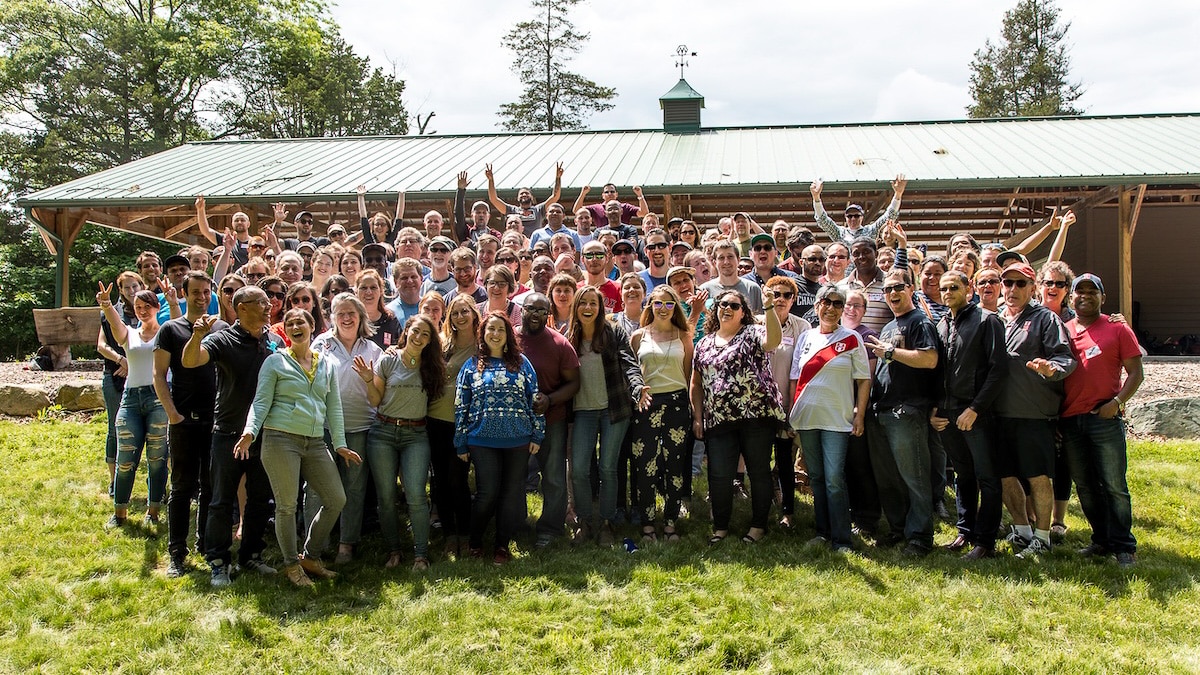


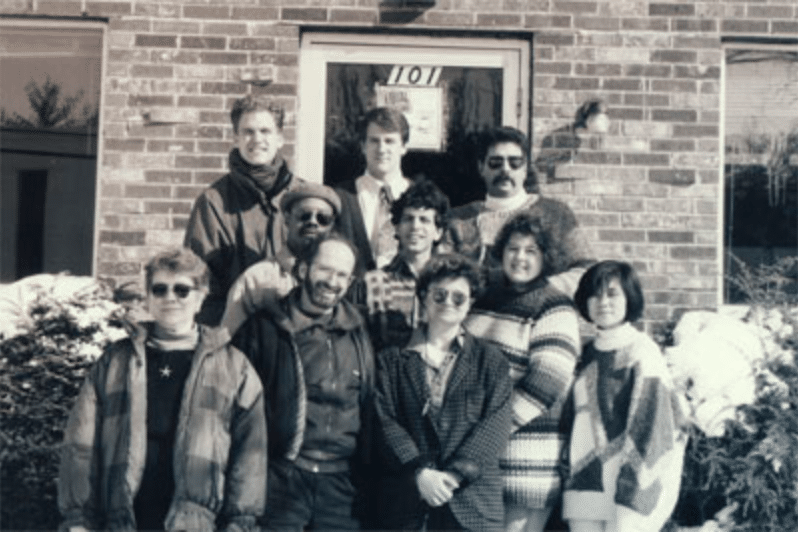
History: Equal Exchange started with an idea: what if food could be traded in a way that is honest and fair, a way that empowers both farmers and consumers? Founders — Rink Dickinson, Jonathan Rosenthal and Michael Rozyne — asked this question as they envisioned a trade model that values each part of the supply chain. They decided to take a big risk and started importing fairly-traded coffee from Nicaragua in 1986, despite a US embargo against the Sandinista government. A new business was born from this bold act of solidarity with Latin American farmers and Equal Exchange grew from there into the current Equal Exchange Ecosystem of cooperative businesses made up of 120+ worker owners fairly trading $80M annually.
Small Farmer Grown: Equal Exchange partners with farmer cooperatives who are democratically organized, sharing resources and decision-making among their members. Collectively, they gain crucial market access and decide how to invest fair trade and organic premiums in their communities. Equal Exchange currently sources from over 40 small farmer organizations around the world.
Trade Model: Equal Exchange was founded as a for-profit but “not a for-profit maximizing” corporation and was organized as a worker-owned coop. The idea was to operate in the marketplace and show that coffee could be bought fairly from small farmers and sold to consumers at the grocery store at fair prices. The model is based on a lower profit margin made up for in volume sales. The more green coffee Equal Exchange can purchase from farmers, the more economical the process is for the co-ops that buy and process the green coffee from their farmer members. The more green coffee Equal Exchange can import and manufacture, the more economical the process is of shipping, roasting, packing, and distributing. Equal Exchange sells directly to a network of independent natural food and cooperatively owned grocery stores. Through these direct relationships, Equal Exchange products like coffee, chocolate, tea, fresh and dried fruits and nuts, Palestinian olive oil, and dates can support independent and community-owned food stores with products that reflect their values and their economic models.
Capital Model: Coffee is harvested once a year, and Equal Exchange buys by the container (40,000 lbs.) Equal Exchange buys millions of pounds of beans and needs millions of dollars of capital to buy them. Coffee co-ops need money to purchase green beans from their farmer members, and farmers need income throughout the year. Equal Exchange understood from the start that capital and control of money were going to be as important as worker ownership and control of the business.
Thanks to out-of-the-box thinkers like Clark Arrington, a capital model was developed that integrated outside investors with worker owners in a unique way. Class B preferred non-voting shares were sold to outside investors. Early investors were warned they might lose their money on the idea of some idealistic people buying coffee from Nicaraguan farmers as a political protest, but the founders managed to raise $100K from friends and family. Investors were aware of the risks and the conditions:
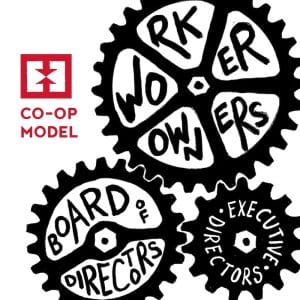
• No voting shares or seats on the board. The board of Equal Exchange is composed of worker owners who purchase and hold all Class A voting shares.
• No guaranteed dividend. Investors like worker owners share in the profitable years of Equal Exchange through higher dividends and share the risks in lower profit years with lower dividends (Note: the average dividend has been 5% over time)
• No windfall from the sale of the company because Equal Exchange has a no sell-out clause and no capital gains because the share value has remained the same over time
This capital model is as radical today as it was in the 1980s and maybe even more so. Money often means power, and we have all seen the negative effects of private equity and maximizing returns for shareholders, both of which have led to massive consolidation in the food industry.
Another source of alternative capital is worker owners. In profitable years, worker owners receive a % of the profits in “patronage”, which is profit sharing. The board votes on the % distributed in cash and the % held by Equal Exchange in an internal capital account. This internal capital is converted to Class B shares, so worker owners, like outside investors, receive dividends. Worker owners together are the largest owners of Class B stock, totaling roughly $1M.