

by Carol Peppe Hewitt
On a sunny spring day in 2010, Woody Tasch, came to our small town of Pittsboro, in the Piedmont of North Carolina, to peddle the idea that we should all invest in our soils. He was on a three-year walkabout, promoting his book, Inquiries into The Nature of Slow Money, and he presented this challenge: If 1 million Americans invested just 1% of their assets in the local food economy within the next decade, the impact would be monumental.
Like the food system as a whole he told us, “the financial model is broken at a fundamental level. Food is the entry point to fix the whole economy. We need a revolution in how we think about our money, and how we feel about it. We need to connect money to the earth.”
Venture capitalists, Woody argued, may have motives that do not square with thoughtful, ecologically-minded community development. Slow Money, (http://slowmoney.org ) the idea he was promoting, could do that and more by combining philanthropy, conscious investing, the success of small farming, and the strengthening of healthy local food systems.
I was on the short list of people invited to hear him speak. His ideas made sense to me so I decided to see if I could turn them into action. In the next few months I sought out small farmers and local food entrepreneurs who had viable needs for capital, but had few, if any ways to obtain it. Then I went looking for ordinary people who were passionate about the importance of local, sustainably grown food. And I introduced them to one another. One by one direct, peer-to-peer affordable loans were the result.
Gary loaned Angelina several thousand dollars so she could pay off the credit card debt she had incurred when she expanded Angelina’s Kitchen (www.angelinaskitchenonline.com ) a few months earlier. Angelina loves using local food in her popular Greek restaurant, and she buys as much local meat and produce as she can push back out across the counter in her Greek salads, Sheperd’s Pies (often made with sweet potatoes), and her famous Green Bake (a dense pie of local eggs and leafy greens.)
When the health department told Lilly Den Farm (http://lillydenfarm.com ) that they needed new labels now for their meat products it was a Slow Money lender who quickly came up $500 to cover their printing costs so Lilly Den could stay in compliance with those regulations. While it might not seem like a lot of money to some, $500 was the difference between being ‘open for business’ or ‘closed down’ for a few weeks for Lilly Den Farm owners, Tucker and MacKenzie Withington.
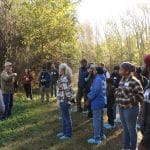
We put up a Slow Money NC (slowmoneync.org ) website so both potential lenders and borrowers could get in touch with us. We held Slow Money NC gatherings to build our network, to enjoy the company of like-minded locavores, and to provide a convivial space for potential lenders to meet the famers and local food business entrepreneurs who needed equipment, or had ideas but needed capital to make them happen. In Rocky Mount, Southern Pines, Asheville, Brevard, Wilmington, Greensboro, and Charlotte folks set up Slow Money NC gatherings. I would tell them about the loans that had been made so far, and share a template for a Promissory Note they could use to do the same. Farmers met potential lenders, shared their ideas, and over and over affordable Slow Money loans were catalyzed. Equally important was the networking that occurred, the sharing of resources and contacts, and the myriad of ways people stepped forward to help one another.
I made it clear that it was entirely up to the lender to decide to whom they wished to lend their money. I told potential lenders – and still do – that this needs to be money you can afford to lose. Sometimes there is collateral, sometimes there is not. There may be elaborate business plans, or just a one-page budget, but there are no guarantees and no insurance – just trust and one’s best judgment as to the ability each business owner has to pay their loan back.
In fact, the large majority of the 75+ Slow Money loans that have been made in North Carolina are performing very well. And our record improves each year. This week five Slow Money lenders financed the second crop of the first organic cotton grown in NC. TS Designs commissioned farmers to grow organic cotton that is being made into yarn, then cloth, and finally local organic t-shirts – all right here in NC. We are not only making loans, we are making history, and it’s the kind we can be proud of.
Why do people lend? As I travel around the state, and soon around the country reading from my own book, “Financing Our Foodshed: Growing Local Food With Slow Money” I tell the stories of generous lenders and hard-working farmers. Repeatedly, I get asked this question. “Why do people make these loans?”
My own initial response is “Because we can.” But digging a bit deeper, and in talking to the 60+ people who have made Slow Money NC loans, I hear several common themes. They are concerned with climate change, economic disparity, and the loss of fertile topsoil.
Supporting sustainable farming and soil fertility is a direct assault on the negative impact of climate change, and on an economic system that is hell-bent to increase the immoral disparity between rich and poor. Increasing access to capital, and increasing the amount of capital that circulates within our local food economies means more readily available local food in our stores and on our tables. Slow Money lending is a powerful way to address all of these issues.
I was invited to speak last night to a group of friends who had formed an Investment Club nearly ten years ago. Disillusioned with the stock market, they are now casting about trying to figure out how to invest locally, in the community they care about. They had heard about Slow Money NC, and my success in matching local lenders to viable small farmer/food projects that need capital to start up, to run more efficiently, or to expand. They sponged up the welcome news that this investment mechanism was straight-forward and easy to do. We discussed the risks candidly, as well as the appeal of an investment that offers a moral as well as a financial return.
The number of Slow Money inspired Investment Clubs is growing around the country. While most of the loans I have catalyzed have averaged about $5000, in the fall of 2011, we pooled our resources for a much larger project.
At our very first Slow Money NC gathering in July, 2010, Paul Finkel suggested that we finance the $300,000 balloon payment that Chatham Marketplace (chathammarketplace.coop ) our local co-op grocery store, had coming due in September 2013. The Marketplace was about three years old, and Paul, who served on their finance committee, knew they were teetering under the weight of the hefty loan payments they had to send off each month to a bank in Virginia.
At the time the idea sounded preposterous. A few of us had made Slow Money loans of $2,000 or $3,000— to a baker, a restaurant, and a cheese shop and $300,000 seemed much too ambitious. But about a year later we took a second look.
Could we raise this money as a group, we asked ourselves? In the past three years this friendly grocery store had transformed the community for so many of us. We no longer needed to trek 30-45 minutes away to reach another coop, or large corporate ‘natural and organic food’ store. We could now enjoy a farm-to-table salad and hot bar, seven days a week, and the cheerful café as a gathering space, right here in our small town of less than 4000 people. Could we find enough Slow Money NC enthusiasts to help with a portion of this refinance proposition?
It turned out that we could, and we did.
We formed a Limited Liability Corporation (LLC) and began looking for 16 individuals to participate at $25,000 apiece, enough to cover the payoff amount, legal costs, and filing fees. One by one, and even two by two, the openings for the 16 participants filled up. In the end, we had to turn people away.
We called ourselves “Bringing It Home Chatham,” (BIHC) because that was exactly what we wanted to do with our money.
On November 1st, 2011, the closing date, BIHC took a new and historic step forward in financing ourselves as a community. (I like to think of this as an Occupy Pittsboro action.)
By now, in the winter of 2013, Slow Money NC has a lively website, a small, very part-time staff, and has catalyzed 75 loans to over 30 small farmers and local food businesses throughout North Carolina. With about $670,000 in loans, we are on our way to getting several million dollars of local money working to build resilience in our local foodsheds.
For those understand the importance of supporting sustainable farming and soil fertility, but who just can’t eat enough local food to make the positive change they want to make in the world, making a Slow Money loan might just be an excellent next step.
Article by Carol Peppe Hewitt set out to make Slow Money loans to small farm and local food businesses in North Carolina, but fast! Since 2010, Hewitt, a local food activist and author of Financing Our Foodshed: Growing Local Food with Slow Money (New Society Publishers, April, 2013) has catalyzed 75 such loans. Her new book is a collection of compelling, real life stories of the Slow Money pioneers – the lenders and local food entrepreneurs: sustainable farmers, bakers and restaurateurs they have chosen to support.
Financing Our Foodshed: Growing Local Food with Slow Money will appeal to anyone who understands the critical importance of sustainable grown local food and resilient local economies and wants a blueprint to get us there.
For more information and to order the book-
financingourfoodshed.com