

One of my favorite memes is the saying, “Women: Like Men, Only Cheaper.” OK, so it’s not actually my favorite. It’s funny, but sadly, it’s also true: there is still a pay gap between men and women in nearly every nation that cannot be explained away by citing gender differences in skills, experience, or education.
The pay gap is one reason women often seek sustainable investing, which goes beyond climate and environmental issues to address poverty, discrimination, and inequality. Women affected by these gaps see sustainability as intertwined with their lived experiences and financial futures.
Solving those problems is just as important as eliminating all anthropogenic GHG emissions and bringing the extinction rate to zero if we want to leave our children a planet that provides them with the means to live comfortably.
Solving biodiversity loss and climate change requires progress on diversity, poverty, and inequality. Women, often most affected by climate change, play a crucial role in addressing it. They are strong at crisis response, collective decision-making, and advancing family and community interests. Women farmers are more productive than men, and families with greater gender equality tend to have fewer children.1 Both factors support climate crisis2 solutions.
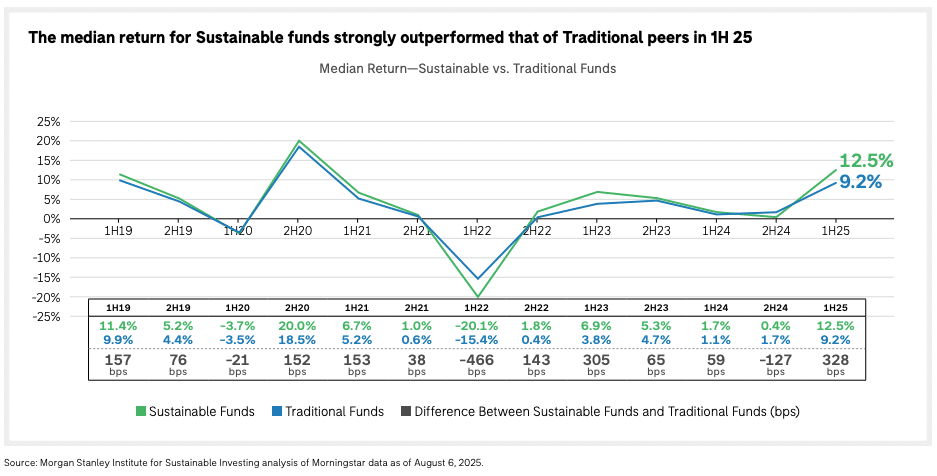
Achieving greater sustainability across all dimensions is half the mission of sustainable investment. The other half is providing competitive returns to investors, because the human race has demonstrated in spades that philanthropy alone cannot solve societal problems. On the latter, it’s possible to say “mission accomplished.”
Sustainable funds have shown performance similar to or better than traditional funds over recent years, according to Morgan Stanley, though they have at times outperformed. The key takeaway: sustainable investing holds up as a sound financial strategy over time, contradicting misconceptions that it is a weaker option for investors.
However, while the world is making progress on reducing greenhouse gas emissions and closing the gender equality gap, it is painfully slow. And progress in reducing biodiversity loss and eliminating all forms of pollution is still on a path that leads to catastrophe. A lot of that catastrophe is decidedly not gender-neutral. Things like pollution and climate change, and certainly the economic and social gender gaps, tend to affect women and minorities far more negatively than men.3 That is one reason women tend to express greater interest in sustainability than men, both in corporate behavior and in lifestyle choices.