His new book claims to have made a definitive list of the most effective global strategies for lowering our emissions. Don’t despair: they’re all totally achievable.
 If you read anything about climate change, it’s not hard to become convinced that we’re screwed.
For instance, here are just a few notable recent apocalyptic warnings: In January, a chunk of ice roughly twice the size of Central Park split off a glacier in Antarctica; within months, another chunk larger than Rhode Island is likely to follow. By 2100, sea levels could rise eight feet. Much earlier–perhaps as soon as in 15 years–drought and disease linked to climate change could begin to kill more than a quarter of a million people each year.
The scale of the problem is familiar, but the specifics of the solution aren’t. Even the pledges made for the Paris agreement, the world’s first comprehensive climate deal, don’t go far enough to keep warming in check. Some climate activists are beginning to organize support groups to deal with their own anxiety. For the public, a sense of helplessness begets avoidance and sometimes denial. Especially with a climate-denying party controlling the government, it can seem that there’s no hope.
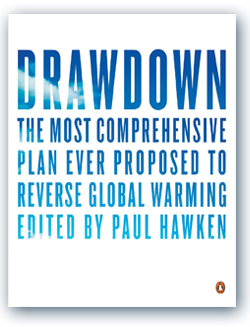
But a new book might change that–and serve as a blueprint for what comes next if the U.S. government (and the global community) begins to aggressively focus on altering the climate future. Drawdown: The Most Comprehensive Plan Ever Proposed To Reverse Global Warming, analyzes the details of what it might actually take not only to stop global warming, but potentially begin to reverse it. To create it, a team of researchers spent two years examining data on the 100 most substantive ways to reduce or sequester emissions, and doing the math on how much those solutions could achieve over the next three decades.
If the top 80 solutions are deployed in combination, aggressively, between 2020 and 2050, they could lead to what the book calls drawdown: the point at which the concentration of greenhouse gases in the atmosphere begins to decline year by year and we avoid the worst (but certainly not all) of the damage that climate change could do to the environment, food system, and human civilization.
Two Decades Left
“It’s really pretty straightforward questions that I had a writer, and a journalist, and as a person: Do we know what to do? How much does it cost?” says Paul Hawken, the environmentalist, entrepreneur, and author, known for influential books about business and sustainability such as Natural Capitalism and The Ecology of Commerce.
Hawken first began asking experts for a similarly comprehensive list of solutions, along with their potential for impact and their cost, in 2001. It didn’t exist. By 2013, after reading an increasing number of articles that suggested it might be too late to avoid catastrophe (see, for instance, James Hansen’s New York Times op-ed “Game Over For the Climate”), he decided to build a team to create the list himself.
If we want to keep global average temperatures from rising two degree Celsius, a target to avoid many of the worst impacts of climate change, the world has a finite budget for emissions of heat-trapping gasses. At current rates–around 40 gigatons of carbon dioxide emissions a year–we have less than two decades left, by some estimates, before we deplete that budget.
“Once we reach that budget, that’s it, forever,” Katharine Mach, a senior research scientist at Stanford University who was not involved with the book, tells Co.Exist. “We need to be at zero emissions at the global scale… That is a massive reworking of how our economy works at the global scale, recognizing that, to date, fossil fuels have actually been phenomenally important for global development.”
For most of human history, the concentration of carbon dioxide in the atmosphere hovered around 280 parts per million, rising and falling small amounts each year as plants absorbed carbon and released it. Over the last few years, centuries of human climate pollution have caused carbon dioxide levels to occasionally rise above 400 parts per million, and as of 2016, it seems to be a permanent condition (in April 2016, the Mauna Loa Observatory also set a new record daily reading, of 409.44 parts per million). The last time levels were this high was the Pliocene Epoch, roughly 3 million years ago.
Achieving Drawdown
The new book considers two types of solutions that could potentially bring that atmospheric concentration down: technologies and practices that can avoid emissions compared to business as usual, and those–like planting trees, or managed grazing, which uses cattle to bring back native grasses–that can help absorb more CO2. Using the best available data, each solution was modeled in three scenarios, each with an increasingly aggressive scale of adoption.
The “plausible” scenario looks at an optimistic but somewhat conservative path for adoption of each solution (trips by bike, for example, are assumed to rise from the current global rate of 5.5% of urban trips to 7.5% by 2050). The “drawdown” scenario scales those solutions up. The final scenario, called “optimum,” looks at the maximum potential of the solutions, such as the adoption of 100% clean, renewable energy. Each scenario ranks the solutions by potential impact.
The most effective solutions aren’t necessarily easy to predict because this type of comprehensive comparison is new. “If you give someone a piece of paper, and said ‘Put the top ten solutions down, in any order,’ no one would get it right,” says Hawken. “No one.”
The scale-up of large solar farms, at number eight on the list in one scenario the researchers considered, could be less impactful than educating girls in the developing world, which is at number six. Women with more education have fewer children, which directly translates into reduced emissions. For the same reason, family planning ranks high on the list.
Both solutions are cost-effective, but haven’t gotten as much attention as sexier technology. “People early on recognized [climate change] as the ultimate super-wicked problem, like humankind has never encountered,” says Hawken. “I think the science at the time–largely men–the feeling was that we need a super-wicked solution, a solution as wicked as the problem. So they just went right to renewables, boom, and efficiency.”
Read the Full article with all its links here www.fastcompany.com/3068250/world-changing-ideas/the-100-things-we-need-to-do-to-reverse-global-warming