Companies and water stewardship, Ceres’ latest benchmark urges faster action on risks

Valuing Water Finance Initiative Benchmark report highlights how companies’ water management practices have improved and fallen short.

Ceres’ latest benchmark of corporate water stewardship shows how companies from four water-intensive industries — food, beverage, apparel, and high-tech — have responded to mounting financial, regulatory, and reputational risks tied to their water use and impacts.  

Coming two years after the first assessment, the new report shows that while companies have made progress — 48 of the 71 focus companies improved their scores — it is uneven and not happening quickly enough, nor at the scale needed to meet escalating water challenges. By 2050, more than 30% of global GDP is expected to be exposed to water stress.  

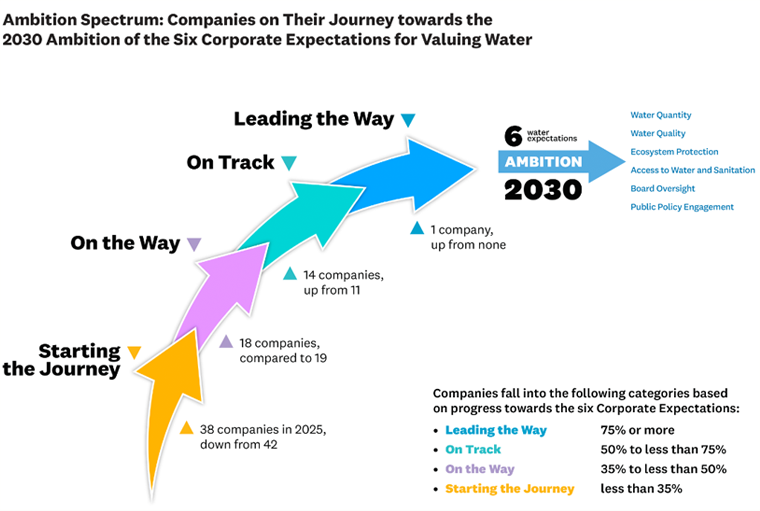
The global water crisis is escalating and with it, financial risks to companies across all industries and their investors. The second edition of the Valuing Water Finance Initiative Benchmark shows how companies across four water-intensive industries — food, beverage, apparel and high-tech — have responded to mounting financial, regulatory and reputational risks tied to their water impacts since the first assessmnt in 2023. This new analysis provides fresh insights into companies’ performance against six Corporate Expectations for Valuing Water, an ambition for companies to achieve by 2030.

The benchmark evaluates company performance against six Corporate Expectations for Valuing Water, a set of goals for 2030 aimed at minimizing impacts on freshwater resources and strengthening ecosystem and business resilience. These expectations guide the Valuing Water Finance Initiative, the only investor-led global effort focused on water action.


The report, developed in partnership with Quantis using publicly available company disclosures, provides critical insights into companies’ vulnerabilities, opportunities, and strengths when it comes to managing water. Though results vary across companies and industries, notable trends have emerged, including:

Companies continue to focus on water availability: 83% of the 71 assessed companies have water use targets, but only half have targets that consider the local conditions of high-risk areas in their value chains. 

Corporate action on water quality remains limited: 41% of the companies have targets to reduce pollution, and few have targets that consider the local conditions of high-risk areas.  Most of the companies report the amount of water they withdraw, and wastewater discharged, in operations and/or supply chains, but not how this impacts water availability and quality where it’s happening.

Companies are engaging more in ecosystem protection or restoration projects with benefits to freshwater but lack goals to ensure progress. 

Most companies have yet to embed WASH (access to water, sanitation, and hygiene) into corporate strategies. 

Companies are improving board oversight of water risk: 73% of companies have formal board and senior management oversight over water-related issues, and half have incentives linked to water. 

Companies have yet to ensure collective action initiatives directly support water goals: just over 40% of the companies with water use targets participate in collective action to help achieve that goal. Even fewer are doing so for water quality.

Sign up for our biweekly Ejournal

Global Events Calendar

Latest Impact Investing News

Featured Video

Sustainability News from 3BL

“This report shows that while water risks are complex, companies are making tangible progress,” said Kirsten James, senior program director for water at Ceres and report co-author. “By offering data-driven insights into how businesses are embedding water risk into operations, supply chains, governance, and strategy, this benchmark can serve as a reference point and catalyst for more ambitious water stewardship across industries.”

The benchmark, in pinpointing where water stewardship gaps persist and emerging best practices and innovations that are driving progress, is a key resource for investors who are engaging with portfolio companies on water risks through the Valuing Water Finance Initiative.

“This report provides a unique and much-needed line of sight into how corporate water stewardship strategies are evolving and how we as investors can meaningfully engage with companies to build strategies that address all aspects of water risk and build long-term business resilience,” said Matt Crossman, Stewardship Director, Rathbones Group Plc

The benchmark can be a valuable tool for companies to draw inspiration and lessons from peers, including successes and challenges within and across industries, to accelerate implementation of best practices and get ahead of setbacks others have experienced.

“Water is at the heart of sustainable food production and resilient supply chains,” said Nici Bush, Chief Innovation, Science and Technology Officer at Mars. “The Valuing Water Finance Initiative Benchmark helps guide and unite businesses in taking meaningful, science-based action on water stewardship where it matters most – in agriculture.”  

“Water challenges and climate impacts continue to increase and addressing the risks is central to business, environment and community resilience. Water is an integral part of our sustainability and business strategy at Diageo, and it has been for many years,” said Michael Alexander, Global Head of Environment at Diageo. “This report supports the importance of this work and provides valuable insights for businesses and other stakeholders to inform strategies and manage risk across all aspects of water stewardship.”  

This report highlights protection of freshwater resources as a strategic imperative for companies — critical for building business resilience and helping ensure the well-being of people and nature throughout their value chains.

“Water security is essential to operating within planetary boundaries, yet it remains under serious threat from climate change and insufficient governance,” said Sara Traubel, Nature Lead Quantis Switzerland. “The 2025 benchmark shows that while some companies are making progress, most are still far from achieving water security by 2030. Only by properly valuing water can companies strengthen their resilience to climate change.”    


About Ceres

Ceres is a nonprofit advocacy organization working to accelerate the transition to a cleaner, more just, and resilient economy. With data-driven research and expert analysis, we inspire investors and companies to act on the world’s sustainability challenges and advocate for market and policy solutions. Together, our efforts transform industries, unlock new business opportunities and foster innovation and job growth – proving that sustainability is the bottom line. For more information, visit https://ceres.org

Globar Events Calendar

Featured Podcast

Sustainability News from 3BL

Sign up for our biweekly Ejournal

Global Events Calendar

Latest Impact Investing News

Featured Video

Sustainability News from 3BL

Latest GreenMoney News

Latest GreenMoney News

Impact investing

Sustainable business​

Turbulence or Transformation-Capital & Innovation by Jackie VanderBrug of Putnam Invest

Food & Farming

Agrivoltaics gives us hope in a divided world by Garrett Chappell