For over 50 years, the Interfaith Center of Corporate Responsibility has engaged companies on ESG risk.
The Interfaith Center on Corporate Responsibility plays a special role in the ongoing dialogues between companies and their investors. Born from a 1971 campaign to divest assets from apartheid South Africa, ICCR’s members, today, conduct active dialogues — engagements, in industry parlance — with companies about an array of environmental, social and governance risks. They do so either behind the scenes or by filing shareholder resolutions, also known as proxy-voting proposals, all the while insisting on the language of fiduciary duty. The membership, about half of which is faith-based, also straddles the craggy divide between values and fiduciary responsibilities that’s a characteristic of sustainable investing. “For over five decades, the ICCR has shaped the practice of investor advocacy, working to protect the human, ecosystems and financial capitals that underpin resilient markets,” says Jackie Cook, senior director within Morningstar Sustainalytics’ stewardship service.
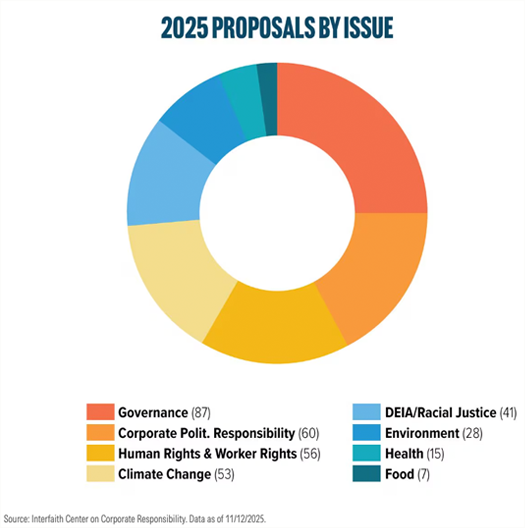
Today, ICCR members are also pushing back on a range of challenges to ESG, including the Security and Exchange Commission’s recent support of leaving many shareholder proposals off proxies, as well as a Texas law that limits proxy advice on so-called nonfinancial factors related to ESG and diversity, equity and inclusion.
“Investors, particularly investors of faith, have a fundamental right to have their investments reflect the values that they hold,” says Mark Regier, vice president of stewardship investing for Praxis Investment Management and Everence Financial, which provide faith-based financial products.
Morningstar spoke recently with ICCR’s Josh Zinner, a former public interest lawyer who became CEO in 2016. The need for ICCR has never been stronger, Zinner argues. He talked about ICCR’s role, why it’s nudging companies to install guardrails around artificial intelligence, and how it’s pushing back on ESG challenges. Keep reading the following excerpts from our conversation to learn what he said.
ICCR’s origins
Leslie Norton: What is the ICCR?
Josh Zinner: We started more than 50 years ago when a group of faith-based investors began engaging with companies about business they were doing in apartheid South Africa. From that, ICCR pioneered a lot of well-known shareholder engagements on social and environmental impacts. Today, it’s a coalition of over 300 institutional investors, including asset owners and asset managers.
We collectively engage with companies on their environmental and social impacts and on good corporate governance practices. We’re at the table with companies as fiduciaries, with the belief that companies that understand their impacts on people and communities and the environment, proactively take steps to mitigate risk and engage in best practices, are companies that are building long-term value in the long term.
Norton: Where does the interfaith part come in today?
Zinner: More than half of our institutional investor members are faith-based. We also have values-based investors, pension funds, asset managers focused on responsible investment, endowments, and others.
ICCR members from our inception have brought to engagements a moral concern about the impact of corporate practices on people and communities and the planet. We bring that lens, particularly our faith-based members, into our investments and conversations with companies. They start with the impacts of corporate practices on society and then have a conversation about the risks and opportunities for companies. We also believe we need to engage with stakeholders, with impacted communities, workers, civil society groups that have issue expertise to understand deeply the experiences and impact of corporate practices and bring that to the table with companies.
Faith-based investors are unique among investors because they can be very explicit. Their fiduciary mandate includes investing with the values of their faith institutions. Other investors are very clear that their own engagement is related to fiduciary reasons and material to the long-term value of companies. Faith-based investors’ fiduciary duty is to align with the faith and values of their denomination. That’s a very important role to play in this environment because of all of the attacks on environmental, social, and governance approaches.
Norton: Tell us about some campaigns, past and present.
Zinner: Over 50 years, we brought issues to companies that were like canaries in the coal mine. For example, our members first engaged the oil and gas industry on methane emissions beginning in 2007. Some 21 US companies tracked responded positively, disclosing critical information and emissions figures, including EQT EQT. Between 2014 and 2018, ICCR members educated companies about the risks of forced labor in their supply chains, driven by the payment of recruitment fees by primarily migrant workers. A Caldwell Dominican Sisters resolution led Archer-Daniels-Midland ADM to adopt a human rights statement prohibiting worker payment of recruitment fees. Engagement by the Congregation of St. Basil led Conagra Brands CAG to adopt a “no fees” ethical labor recruitment policy, as did Walmart WMT. Also, between 2017 and 2023, ICCR members engaged with companies around the opioid crisis. Member pressure led AmerisourceBergen (now Cencora COR), Mylan Labs (now Viatris VTRS), and Teva Pharmaceuticals TEVA, to agree to issue reports detailing how their boards are increasing oversight of opioid risks.
A hallmark of ICCR engagement is that we point out risks companies aren’t aware of. We bring them [these insights] as fiduciaries, but also out of moral concern, so companies can manage them proactively. ICCR members were some of the first investors to bring concerns about climate risk to companies. They engaged with big banks about financial risks around collateralized debt obligations and derivatives leading up to the financial crisis. They were some of the early investors that were concerned about workplace conditions in the maquiladoras.
Today, we’re talking to companies about living wage, about worker health and safety in the gig economy, forced labor in supply chains, and the impact of lobbying and political spending on company reputation, democracy and systems. We’re some of the lead investors bringing human rights concerns to companies, especially in tech sector and AI, and trying to push companies to proactively understand what their human rights risks are in operations and supply chains and address them.
AI risks and climate risks
Norton: What else is top of mind for your membership today?
Zinner: The policy environment, including, more broadly, deregulation, on issues that we care deeply about, whether it be climate or worker rights or health equity. Another is artificial intelligence and, specifically, guardrails around AI. We all understand that AI is inevitable and will be a key part of our economy, and there are positive aspects to it. Our concern as investors is the rapid growth, and the absence of leadership in Washington in terms of putting regulatory guardrails around AI growth and deployment. This is a very important area for investor engagement—talk to companies about their governance structures around their deployment of AI, how they’re managing risk, cybersecurity, privacy, and commercial and human rights risks.
Corollary to our climate program is the massive, rapid growth of data centers, and the impact that has on the transition to net zero emissions and, frankly, on communities where data centers are sited.
The limits of proxy-voting proposals
Norton: How effective is engagement? What is the role of the shareholder resolution?
Zinner: This is an age-old challenge. Today, we’re potentially losing some of our points of leverage, which are shareholder resolutions. It’s always been critical to track the effectiveness of engagement, because otherwise you’re just having a circular conversation with companies. We have a database where our members track the progress of “an ask” of companies, and then use external benchmarks, feedback from stakeholder groups, and other ways to measure progress. Shareholder resolutions were a more public way to highlight these issues, but were never the end result. They were a way to encourage a more robust dialogue and lead toward commitments.
We’ve always measured progress through commitments that companies have made. Then we track internally whether they’re implementing these commitments. Many of the commitments we can’t announce publicly, so we track that measurement internally.
We ask companies to make their commitments public so they can acquire a positive reputational advantage, but also become leaders in the sectors, and create a race to the top. Often, now, companies aren’t willing to make these commitments public.
What’s next for Shareholder Engagement and ESG Advocacy?
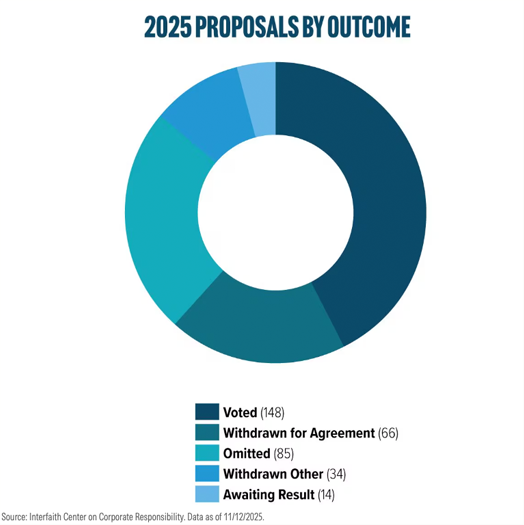
Norton: In the past year, the SEC’s new guidance significantly impacted engagement and reduced the number of environmental and social proposals on proxy ballots. What does it mean for investors?
Zinner: The reason we’re determined to stay at the table with companies is that in this environment, with all the deregulation going on, there are very few guardrails on corporate conduct. These investor conversations with companies are critical.
ICCR members are at the table with hundreds of public companies every year. Dialogue is really the linchpin of engagement. Our members file shareholder resolutions when dialogues are stuck. Resolutions are a way of bringing the issue before fellow shareholders, the board, management, and also to the public, in the hope of bringing companies back to the table. Obviously, even before the current administration, there was a lot of pushback on shareholder engagement and ESG investing. That has accelerated under the current administration.
We’ve been engaging with policymakers, companies, and trade associations, because we fundamentally believe that these are fundamental issues of long-term risk and long-term value to companies. The shareholder resolution process for decades has been a valuable public/private ordering process that enabled very productive conversations leading to many improvements in governance and in company policies and practices. So we’re communicating that message far and wide. There’s a serious risk that shareholder rights will be curtailed, either through the SEC or through litigation.
Norton: Speaking of litigation, ICCR joined a lawsuit to block SB 2337, a Texas law that aims to limit proxy advice based on so-called nonfinancial factors such as those related to ESG and DEI. Please tell us why ICCR is taking this step and why this matters to investors.
Zinner: SB 2337 defines the term “proxy advisor” so broadly as to potentially encompass the work of many organizations working on and around shareholder advocacy. It’s a clear infringement on free speech protected by the First Amendment. The law carries heavy penalties and would block organizations that provide proxy-voting advice and research from providing any recommendations or support for shareholder proposals related to “ESG” or “DEI,” including forcing such organizations to announce to clients and members as well as publicly that the advice given “is not provided solely in the financial interest of shareholders.” By imposing the state’s political views on all investors, this law is an unacceptable attack on constitutionally protected rights, and on the fundamental right and fiduciary duty of investors to invest with a long-term lens. A robust and dynamic economy requires honest competition and the free exchange of ideas that leaders in Texas are seeking to undermine with this law.
Norton: What happens if shareholder resolutions are curtailed? The SEC is considering leaving them off proxies.
Zinner: As long as we can file them, we’ll file them. And if shareholder resolutions are shut down, investors are going to have to take other measures, like vote-no campaigns on boards, shareholder litigation. We’ll continue to be very active in engaging with companies because these dialogues are really vital, particularly in this time when there’s a lot of pressure on these companies to go backward on key issues like climate risk.