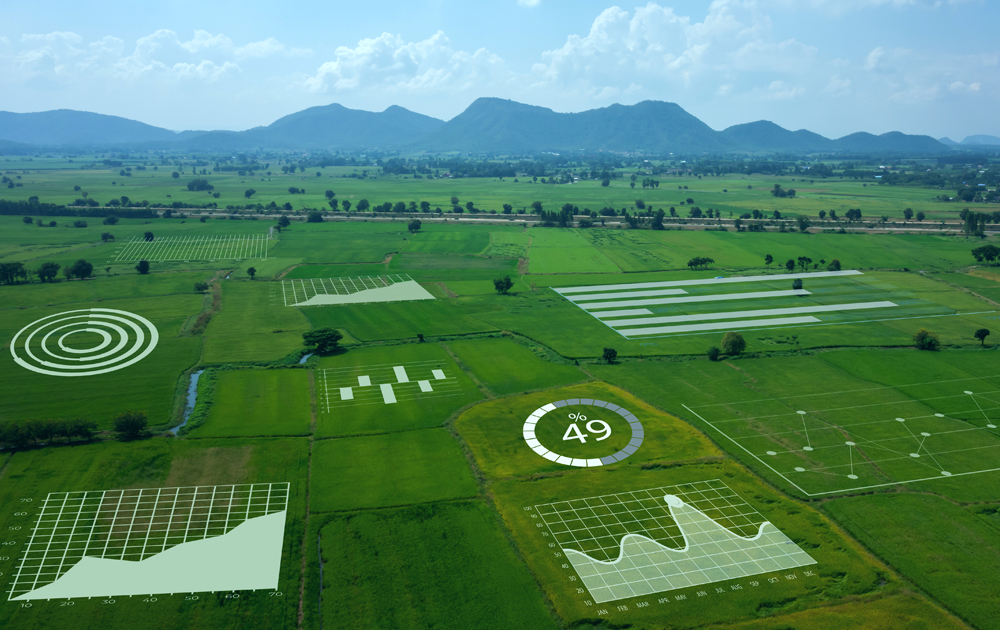


The above image illustrates MRV (Measurement, Reporting and Verification), a system used to monitor, document and confirm the outcomes of agricultural practices.
Feeding the world in the decades ahead is one of humanity’s greatest challenges. By 2050, the global population is projected to reach nearly 10 billion people, requiring roughly 70% more calories than are produced today. Yet water supplies may fall 40% short of global needs by 2030, and nearly a quarter of the world’s arable land is already degraded. On our current path, the math doesn’t work.
Farmers everywhere are grappling with how to increase productivity while protecting their land and resources. At Farmland LP, we see artificial intelligence (AI) emerging as one of the most promising tools to help achieve both goals. But unlike many industries that rush to adopt the latest technology, agriculture has little margin for error.
Farmers get one shot per year to plant, grow, and harvest a crop. Our approach is to integrate AI where it solves clear problems today, while methodically building the data and systems that will support regenerative farming for decades to come.
This approach is not about chasing trends. It is about building a foundation for large-scale, sustainable agriculture that will empower our workforce, protect our soil, and produce healthy food at scale.
What AI can do for farmers
AI refers to systems that can learn from data, recognize patterns, and support decision-making. On farms, these capabilities are already visible in tools that integrate drones, smart sensors, and satellite imagery. AI-enabled platforms can:
• Detect soil and crop conditions earlier than the human eye, allowing for targeted irrigation or compost application.
• Identify pest or disease outbreaks before they spread, reducing the need for broad-spectrum treatments.
• Optimize irrigation by analyzing weather, soil moisture, and plant stress, conserving water while protecting yields.
• Streamline farm management by integrating disparate data from planting records to financial tracking into one “single pane of glass.”
• Provide proactive alerts to farmers and managers when anomalies emerge, from irrigation stress to budget deviations, enabling faster and more effective responses.
Each of these uses serves a dual purpose: boosting efficiency and improving ecological outcomes. Healthier soils sequester more carbon. Smarter water use reduces energy demand. Targeted interventions mean less waste and fewer inputs.
A pragmatic approach to AI on the farm
Farmers are rightly cautious adopters of new technology. Each innovation must prove itself in the field, year after year. That’s why the best approach to AI adoption is iterative — start small, learn quickly, and scale what works.
In May 2025, Farmland LP partnered with Microsoft’s Digital Impact Studio to explore AI’s role in agriculture. Together, we identified roughly 35 potential applications of AI in our operations and prioritized 15 with the clearest near-term value.
The first step is integrating data scattered across multiple systems — accounting, geospatial mapping, farm management records, and field notes — into a unified platform. This “single pane of glass” provides a trusted foundation where farm, financial, and ecological data can be seen together. From there, we can layer on tools like conversational copilots, predictive crop models, and intelligent alerts that deliver actionable insights in real time.
For farmers and managers, this means less manual reporting and more timely decisions. For investors, it means scalable systems that improve both profitability and resilience.