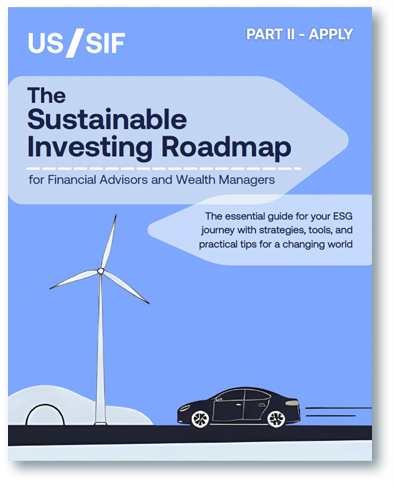
When writing the sequel to the Sustainable Investing Roadmap for Financial Advisors and Wealth Managers, I was rather excited to do so, but I didn’t want to simply add another white paper to an already crowded space: I wanted advisors to be as excited as I was to understand both the potential and limits of ESG data.
Of course, the ESG landscape is challenging to navigate, even for those with many years of experience. It’s very encouraging that financial advisors recognize that ESG issues are important, and they are interested in knowing more about sustainable investing. However, the tools and resources that advisors are expected to use to explain ESG risks to clients were not always built with their needs in mind.
Part II of the Roadmap Series, aptly named “APPLY”, was designed for these advisors. It is meant to be a practical companion in a world where ESG ratings are sometimes helpful, often confusing, occasionally contradictory, and always evolving. Above all, it recognizes a truth that too few ESG data sources are willing to admit: advisors deserve nuance, transparency, and honesty, not a sales pitch.
Why advisors deserve this guide
Part I of the Roadmap series introduced the “why” behind sustainable investing — the history, the taxonomy, and the spectrum of client motivations. However, I knew what the next question would be as soon as the market had time to take it in: How do I actually apply ESG information in real-world portfolio construction?
We know that ESG data has become the central point of confusion in the advisor community. The system is full of inconsistencies: companies with wildly different ratings depending on the provider, disclosure gaps that undermine comparability, methodological divergence that produces disagreement, and marketing language that obscures more than it reveals. In EY’s 2024 survey, for example, 88% of institutional investors reported increasing their use of ESG data, yet roughly 85% also believed greenwashing had worsened over the previous five years¹. Those numbers reflect both the demand for better information and the distrust surrounding it.
Part II was built to help bridge this gap: to give advisors a roadmap they can use when making decisions, conducting due diligence, and explaining sustainability concepts to clients without oversimplifying or overpromising results.
A major theme of the guide is resetting expectations around what ESG ratings are designed to do. Contrary to their marketing reputation, ESG ratings do not measure how “good” a company is, nor do they quantify a company’s “impact”. They do not track how much positive change a company creates in the world or whether it aligns with an investor’s personal values. While the same data, figures, and statistical information used in calculating the ESG ratings can also be used in the calculation of impact scores, they are two separate and distinct measurements and must be treated as such. (NOTE: Part III will lean into the impact world).
What ESG ratings do measure is how effectively a company manages risks and opportunities that could influence long-term financial resilience. In that sense, they are closer to specialized risk metrics than moral judgments: in other words, a kind of operational sustainability report card. They assess issues such as emissions intensity, data security, labor practices, supply chain oversight, or board accountability. However, the ratings are a reflection of each rating agency’s unique lens, weighting system, and assumptions.
This is why the same company can be rated a leader by one provider and a laggard by another. One agency may emphasize governance, another climate transition readiness, and another, social controversies. These disagreements aren’t evidence that ESG is broken, but they prove that there is not one solitary definition of ESG criteria. As such, a field built on diverse methodologies, each with its own strengths and weaknesses is bound to have a few blind spots, and advisors should be aware of them.
Part II teaches advisors how to interpret these scores: by understanding the scales, reading the underlying pillar scores, comparing companies within the correct peer groups, tracking trends over time, and focusing on the rationale behind a score rather than the number alone. ESG data becomes a tool for asking better questions, it is not simply a calculator that spits out answers.
The limitations of ESG data
After years of working with financial advisors, I know they are not afraid of complexity: what they fear is being misled, or worse, putting their client into a product that doesn’t match the “description on the label”.
It is for this reason that Part II gives an honest discussion about the limitations of ESG data. It cannot predict short-term performance or replace traditional financial analysis. Nor can it capture every risk, ensure perfect accuracy, or deliver a standardized comparison across all providers. It cannot guarantee ethical behavior or positive social impact, and ESG data won’t answer every client question with precision.
Recognizing these limitations is not a reason to abandon ESG. On the contrary, it enables advisors to use ESG information responsibly, as one more layer of intelligence within a broader analytical framework. Advisors who understand the imperfections of ESG scores are better positioned to interpret them, contextualize them, and communicate their relevance to clients with clarity and integrity.
Greenwashing, greenhushing and emerging risks
At the core of the modern advisor’s responsibilities is to distinguish authentic sustainability efforts from marketing-driven claims. Increasing regulatory scrutiny reflects what advisors have known for years: sustainability messaging often gets ahead of sustainability practice.
This roadmap doesn’t just dive into greenwashing — the well-known practice of exaggerating sustainability credentials — but also greenhushing, where companies deliberately understate or obscure their sustainability commitments due to political pressure or legal concerns. These dynamics affect investment products just as much as corporations.
Advisors need practical tools to navigate this ever-evolving environment. The guide provides a clear framework for evaluating sustainability claims, identifying red flags, and assessing whether a company or fund is backing its words with transparency, data, and verifiable outcomes. It also helps advisors initiate conversations with clients about these risks in a way that helps builds trust rather than confusion.
Looking beyond public equities
A common misconception is that ESG integration only applies to selecting stocks. In reality, sustainability considerations now shape decisions across every asset class. Green bonds, social bonds, and sustainability-linked bonds are reshaping fixed income markets. Private equity and venture capital increasingly fund early-stage climate solutions and impact-driven startups. Real assets, from renewable energy infrastructure to sustainable timber and agriculture, can also offer tangible contributions to long-term systemic transitions.
We help guide advisors through the sustainability characteristics of these asset classes and explain how ESG data and material risk frameworks apply differently depending on the investment vehicle. It also acknowledges frontier areas, such as sustainable crypto assets, where advisors must remain cautious but informed.
Sustainability is not a style box, but rather a lens that can and must be applied to the entire portfolio.
Why the Investment Policy Statement (IPS) is the unsung hero of ESG
If there is one tool that can solve half the communication challenges around ESG, it is the Investment Policy Statement, the IPS. In Part II, we give proper airtime to discuss the IPS because it turns ESG from an abstract conversation into a disciplined, documented process.
A well-constructed IPS translates client values into concrete guidelines. It establishes sustainability objectives, sets boundaries around risk tolerance, outlines the screening or integration approach, defines asset allocation targets, names relevant frameworks (such as SASB or TCFD), and sets expectations for monitoring and reporting. In an environment where advisors are being asked to justify decisions, respond to regulatory changes, and guard against accusations of greenwashing, documentation is essential.
The IPS also strengthens the relationship between advisor and client by creating transparency around trade-offs, such as how certain sustainability priorities may affect diversification, return expectations, or liquidity. When sustainability is clearly defined from the beginning of the client-advisor relationship, the portfolio becomes easier to manage, and the conversations become easier to navigate.
At its core, Part II is about advisor confidence
More than anything else, Part II was written to give advisors the confidence to ask better questions, to interpret ESG data with nuance, to identify gaps in disclosures, to navigate political noise, to speak candidly about greenwashing, to understand when ESG adds value and when it does not, and to guide clients through a rapidly evolving landscape with clarity and credibility.
Sustainable investing is evolving, but things are not getting much easier for advisors to navigate. Data systems are evolving, regulations are tightening, and investor expectations are rising. Advisors need a roadmap that acknowledges reality rather than sugarcoats it. This is exactly what Part II aims to provide: a thoughtful, balanced, practical guide grounded in both rigor and humility.
ESG data does not need to be perfect for it to be useful. However, advisors need to understand what its limits are — what it can and cannot do. With that understanding, ESG becomes not a political argument or a marketing buzzword, but a meaningful part of long-term risk management and client-centered portfolio construction.
To download US SIF’s Financial Advisor Roadmap Series CLICK HERE.
Article by Jennifer N. Coombs, the Head of Content & Development at US SIF: The Sustainable Investment Forum and an adjunct professor at the College for Financial Planning. A nationally recognized expert in sustainable investing, she created the Chartered SRI Counselor (CSRIC) designation — the first U.S. professional credential dedicated to ESG and sustainable investing — and has been honored as CFFP’s Faculty of the Year and an Investment News 40 Under 40 honoree. Jennifer is also a columnist, speaker, and author leading major industry-wide education initiatives in sustainable investing, including US SIF’s Financial Advisor Roadmap Series. She lives in Vermont.
Footnote:
[1]. EY, Global Corporate Reporting and Institutional Investor Survey, 2024.