Growing up on my grandmother’s ranch in Montana, I learned early that taking care of the land means it takes care of you. Five generations of my family understood this fundamental truth — that business success and ecosystem health aren’t separate concerns, but deeply interconnected realities. The smell of sagebrush after rain or the fragrance of cottonwoods in spring and fall weren’t just poetry to us — they were the indicators of a thriving system that sustained our livelihood.
Today, after 23 years of work in sustainability and as CEO of Biomimicry 3.8, I see this same principle playing out on a global scale. The relationship between business success and ecosystem health has never been more critical—or more quantifiable. As investors navigate an increasingly complex landscape, the truth my ranching family knew becomes clear: Nature isn’t just an environmental side note; it’s fundamental to long-term business viability and economic prosperity.
The $44 trillion reality check
The World Economic Forum reveals that $44 trillion in economic value generation — over half the world’s GDP — depends on Nature. According to S&P Global Sustainable1, 85% of the world’s largest companies have significant Nature dependencies across their operations. From technology companies relying on rare earth minerals to agricultural giants dependent on healthy soil and pollinators, every sector faces Nature-related risks.
The dependencies run deeper than obvious sectors. That cutting-edge data center powering AI? It consumes enormous water quantities for cooling, electricity from natural resource-dependent systems, and up to 1,000 acres of land. Supply chains moving products to your doorstep traverse ecosystems whose disruption can halt global commerce. It’s nearly impossible to find a company without Nature dependency.
The $83 billion wake-up call
The financial consequences aren’t theoretical — they’re happening now. A BloombergNEF analysis of 10 major companies shows over $83 billion in direct losses from poorly managed Nature interactions. The World Economic Forum warns that biodiversity loss could shrink global GDP by $2.7 trillion annually by 2030. Real impacts include:
• 3M faces $10.5 billion in settlements for “forever chemicals,” with potential liabilities reaching $25 billion
• PG&E’s wildfire-related bankruptcy cost over $5 billion in shareholder value as share prices fell 91%
• JBS faced IPO delays and ongoing legal challenges from deforestation allegations
Without strategic Nature investments, businesses face existential threats. Ecosystem collapse is not just an environmental problem—it’s the unraveling of the systems that sustain civilization itself.
In my sustainability journey, I realized we’re not going to solve problems by continuing to address them after we create them — we need a better way to design on the front end. This insight drew me to biomimicry, an ancient practice now equipped with modern frameworks and tools.
After 3.8 billion years of evolution, Nature has solutions for our pressing challenges. Biomimicry — learning from and emulating Nature’s strategies — offers a roadmap for transforming extractive systems into regenerative ones. And frankly, it’s deeply inspiring. Who doesn’t want to be more connected to Nature? In these uncertain times, it is my connection to land and being surrounded by Nature that calms every bit of my nervous system.
Biomimicry operates on three interconnected and interdependent principles: emulating Nature’s genius, reconnecting with Nature as a teacher rather than a resource to exploit (while remembering that we are Nature, too), and ethos, acting with generous reciprocity. Leveraging our understanding of Nature’s functions and processes can yield solutions that work in harmony with natural systems, for examples:
• Zero waste through circular systems: One organism’s “waste” becomes another’s nutrients across a food web of interactions
• Adaptation for resilience: Ecosystems deftly manage disruptions through diversity and adaptation
• Strategic collaboration: Interspecies competition is energy-intensive; species differentiate and collaborate to optimize resource flows and distribution
In short, biomimicry is about designing as Nature does — creating systems that are waste-free, self-organizing, adaptable and collaborative. These are precisely the qualities that drive resilient and profitable businesses. After 3.8 billion years of R&D, Nature has perfected the art of thriving sustainably, and smart investors are finally paying attention to the world’s most successful systems designer.
Revolutionary returns across industries manufacturing breakthroughs
Swiss engineer George de Mestral’s observation of burr seeds on his dog’s fur created Velcro, spawning entire new industries. Today, companies like Sharklet Technologies leverage shark skin-inspired surfaces for healthcare markets, offering chemical-free solutions that reduce hospital liability while improving patient outcomes. A notable biomimicry manufacturing success is Bolt Threads’ production of artificial spider silk. By studying the protein structure and spinning process of natural spider silk, they developed a synthetic fiber with exceptional strength and flexibility that is five times stronger than steel by weight. This biomimetic material is now used in bulletproof vests, parachutes, and sports equipment, providing a sustainable alternative to petroleum-based synthetics and reducing environmental impact through biodegradable and renewable sources.
According to a 2024 market analysis report by Market Growth Reports, the biomimetic materials market was valued at approximately $24.5 billion in 2024 and is projected to grow to nearly $38.6 billion by 2033, expanding at a compound annual growth rate (CAGR) of 5.2%. The report highlights that this growth is fueled by increasing demand for lightweight, durable, and sustainable materials across diverse sectors such as aerospace, healthcare, automotive and construction.
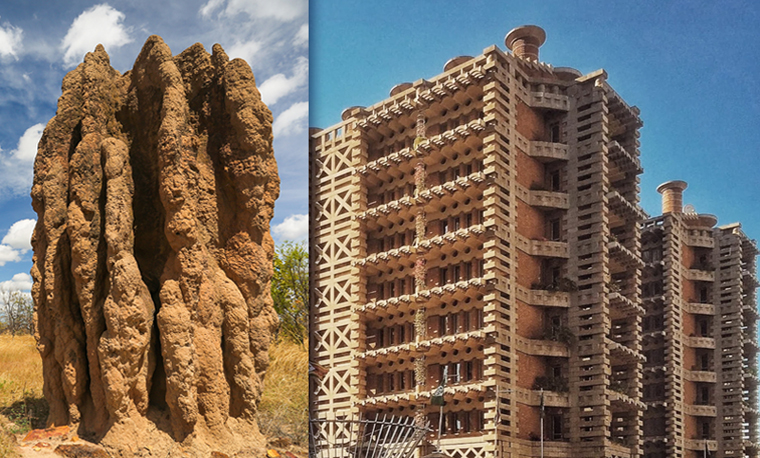
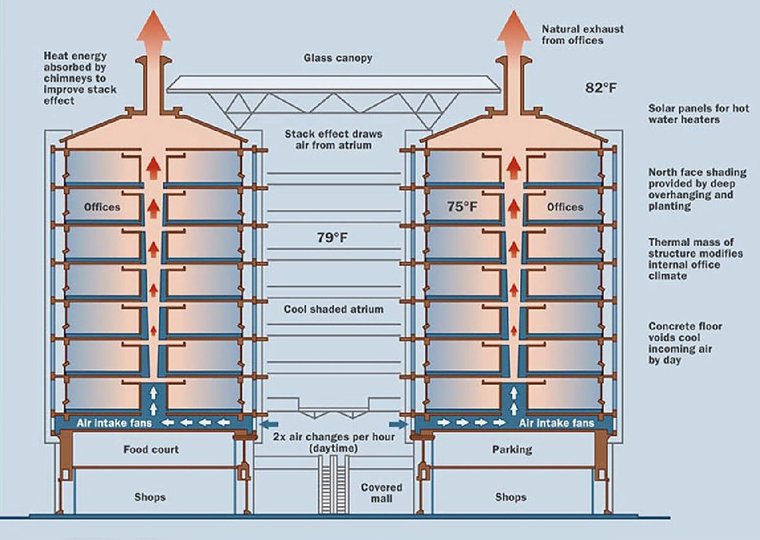
The Eastgate Centre in Zimbabwe (built in 1996) leverages termite mound-inspired passive cooling, cutting energy consumption for heating and cooling by 90% and upfront costs by 10%. By eliminating conventional air conditioning, the Centre enables competitive rental pricing while delivering strong returns in emerging markets.
Architect Mick Pearcedesigned probably the first building in the world to be cooled by entirely natural means – inspired by the ventilation design of termite mounds. Constructed like a chimney, the mound warms by the sun during the day, and by nightfall, the air inside the mound is warmer than outside. As the outdoor temperature falls, warm air naturally vents out the top of the chimney, which draws cool air in through underground tunnels.
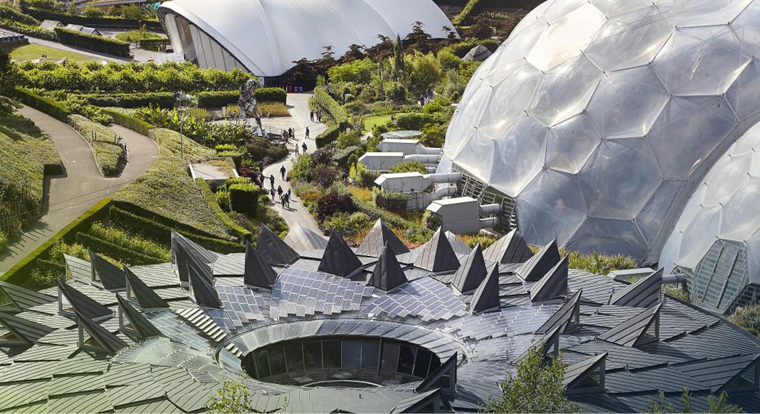
The Eden Project’s hexagonal patterns borrowed from Nature were built with lightweight ETFE (ethylene tetrafluoroethylene), delivering superstructure costs one-third of conventional glasshouses while halving operational energy use. This biomimetic approach helped generate over $1.3 billion for the local economy, demonstrating commercial and community value.
These are just two examples; the built environment at large has continued to demonstrate substantial and accelerating opportunity for Nature-inspired design and innovation. Recent analysis from Global Market Insights projects the biophilic design market reaching $3.14 billion by 2028, growing at over 10% annually, while broader green building markets are projected to exceed $1 trillion by 2030 according to industry forecasts. Green building materials represent a $285.89 billion market in 2024, expected to reach $458.61 billion by 2030, reflecting strong regulatory pressure and corporate sustainability targets. This growth, driven by consumer demand for wellness-focused development that integrates natural materials, organic shapes, and regenerative design principles, presents substantial investment opportunities in Nature-inspired built environments.
The message is clear: Nature-inspired design is no longer niche — it’s shaping the mainstream economy.
Agricultural transformation
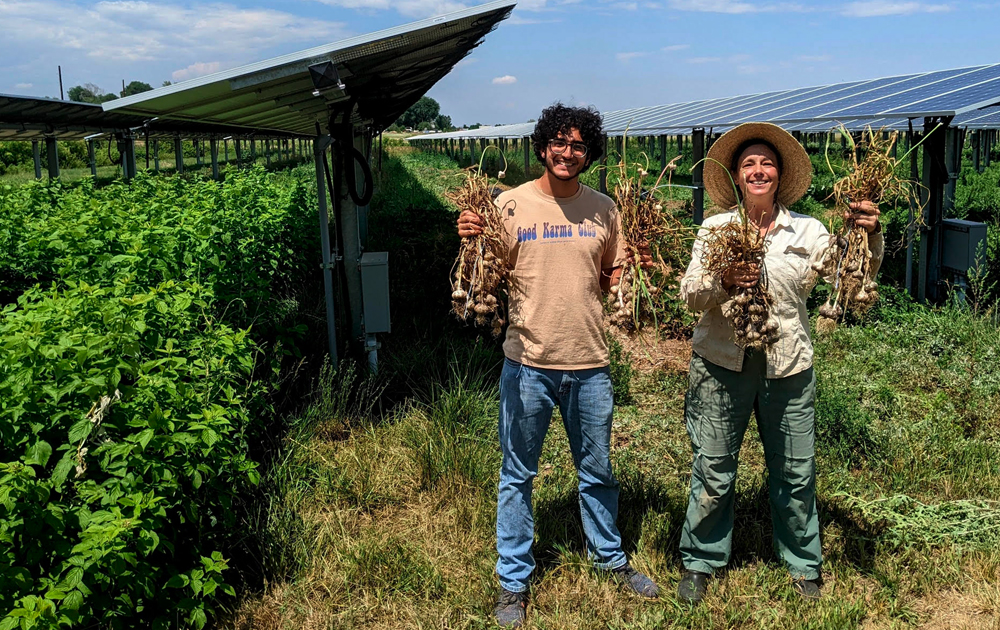
Regenerative agriculture represents perhaps the most dramatic financial transformation, and it resonates deeply with my ranching heritage. The Land Institute exemplifies biomimicry in regenerative agriculture by developing perennial grain cropping systems modeled after natural prairie ecosystems. Their approach uses deep-rooted perennial plants and polycultures that mimic prairie diversity, leading to sustainable, resilient food production that reduces soil erosion, lowers dependence on synthetic fertilizers and pesticides, and improves carbon sequestration. This system enhances soil health and water retention while maintaining crop yields, aligning closely with natural processes to create a self-sustaining agricultural model that supports ecological balance. Grand View Research values the global market at $12.66 billion in 2024, projected to reach $57.16 billion by 2033 — an 18.7% annual growth rate. The returns are compelling: 15-25% ROI for farmers transitioning to regenerative practices at scale. While regenerative fields may yield 29% lower grain production, they generate 78% higher profits due to reduced input costs and premium pricing. My grandmother would have understood this — healthy land produces sustainable profits.
Beyond “Less Bad”: nature-positive leadership
I’ve witnessed leading companies embed Nature-positive practices not as sustainability gestures, but as strategic responses to risk and value creation:
Patagonia embodies nature-positive leadership by integrating environmental activism deeply into its business model, which in turn creates strong brand loyalty and business value. The company’s mission, “We’re in business to save our home planet,” guides decisions across materials sourcing, manufacturing, and advocacy, resulting in sustainable products and authentic engagement with environmentally conscious consumers.
Interface implemented Biomimicry 3.8’s Factory as a Forest framework, defining ecological performance metrics for carbon sequestration and pollutant removal – “…pollutant removal. In simple terms, it’s a way of designing factories to function like healthy forests — cleaning air, storing carbon, and giving back more than they take” Combined with carbon-negative goals and closed-loop design, this provides competitive differentiation in a building materials industry increasingly judged on ecological impact.
Microsoft protects 40% more land than it uses while investing in large-scale ecosystem restoration. By integrating Nature-based thinking into water-efficient datacenters and circular product design, Microsoft is reducing operational risks while using AI for biodiversity monitoring — creating competitive advantages and regulatory readiness.
The ancient practice, modern opportunity
Biomimicry is not new. What excites me most is that it is an ancient practice — indigenous cultures have always looked to nature for design wisdom. What’s new is our ability to apply modern frameworks, playbooks, and technology to scale these solutions across industries, engaging with a large community of practitioners who are eager to do the same.
We have more examples now than ever before. As more companies and industries prepare to redesign for resilient and regenerative outcomes, biomimicry provides the systematic approach they need. Rather than incentivizing short-term, extractive impacts, there is unprecedented opportunity to invest in companies delivering regenerative outcomes benefiting all life.
As Robin Wall Kimmerer wisely states: “Sustain the ones who sustain you and the Earth will last forever.”
Montana wisdom meets Wall Street
Companies and investors recognizing Nature as a strategic asset—not just environmental concern — will capture the greatest opportunities ahead. With more than half of global GDP dependent on Nature and biodiversity loss ranking among the top three risks over the next decade, the question isn’t whether to invest in Nature — it’s how quickly you can start. Whether you’re an investor, entrepreneur, or policymaker, the first step is to audit and understand your own nature dependencies so you can shift from extractive practices to regenerative ones, building businesses that thrive alongside the planet.
The frameworks exist. Nature’s solutions are proven. The time for action is now. Those embracing Nature’s wisdom will build resilient, profitable businesses contributing to a thriving planet. Those ignoring 3.8 billion years of evolutionary lessons do so at their peril.
From my grandmother’s ranch to the boardrooms of Fortune 500 companies, the principle remains the same: take care of the land, and it takes care of you. In a world where 85% of the largest companies depend significantly on Nature, protecting Nature means protecting profit, progress, and prosperity for generations.
The path forward begins with recognizing Nature not as something to exploit, but as something to learn from, partner with, and regenerate alongside. And in these uncertain times, when we all need something to calm our nervous systems, what could be more reassuring than aligning our business strategies with the wisdom of systems that have thrived for billions of years?
Article by Nicole Miller, who transforms how global companies innovate by unlocking nature’s 3.8 billion years of proven solutions. As CEO of Biomimicry 3.8, she leads a social enterprise dedicated to creating a more sustainable world through nature-inspired innovation.
Drawing on 22 years in corporate sustainability, Nicole has guided organizations including Google, Johnson & Johnson, Microsoft, and Interface in developing breakthrough strategies and solutions modeled after natural systems. Since joining Biomimicry 3.8 in 2012, she has spearheaded partnerships and initiatives that make biomimicry accessible to innovators worldwide, bridging the crucial gap between scientific discovery and market application.
Nicole practices what she teaches, finding inspiration and balance through her connection to the natural world in Montana, where she lives with her family and a growing number of pets.